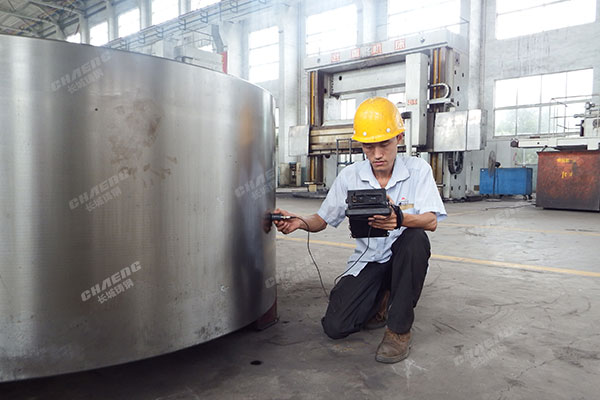
The basic principles of ultrasonic testing for large steel castings
29 Dec 2025 UTC+8Views:


The basic principle of ultrasonic testing for large steel castings is that when high-frequency, short-wavelength ultrasonic waves are emitted from a probe into the casting, the method of detecting internal defects in the casting is based on their acoustic
Ultrasonic vibrations, depending on the modulation method, can produce continuous waves or pulsed waves. The method that uses the echoes from the defect and the bottom surface to determine the presence, size, and location of the defect is called the pulse-reflection method. Using continuous waves, there is the penetration method, which determines the defect condition based on the sound waves formed by the scattering, reflection, or absorption of ultrasonic waves at the interface with the metal matrix, and the resonance method, which determines the presence of heterogeneous interfaces (defects) based on the sudden change in the frequency of ultrasonic standing waves caused by resonance in the tested casting. Since the pulse-reflection method is the most widely used, this section only describes this method. For general-purpose and high-pressure cast steel parts made of non-austenitic steel, please refer to GB/T 7233.1-2010 "Ultrasonic Testing of Steel Castings Part 1: General Purpose Steel Castings" and GB/T 7233.2-2010 "Ultrasonic Testing of Steel Castings Part 2: High-Pressure Steel Castings".
Ultrasonic testing, with its excellent penetration capabilities, high sensitivity, precise defect localization, high efficiency, safety, and cost-effectiveness, has become the "gold standard" method for internal quality control and evaluation of large steel castings. It is particularly suitable for detecting volumetric defects and dangerous planar defects within castings, providing reliable technical assurance for ensuring the structural integrity and safe operation of large critical castings (such as wind turbine hubs, hydraulic turbine runners, nuclear power equipment, and large machine tool bases). In practice, ultrasonic testing is often combined with magnetic particle or penetrant testing to achieve comprehensive control over both the internal and surface quality of castings.
Xinxiang Great Wall Steel Casting Co., Ltd. possesses imported physical and chemical testing equipment, offering a wide range of specifications and advanced technology, with a commitment to achieving excellence in quality and ensuring high-end, high-quality products. The company is capable of performing hardness testing, magnetic particle testing (MT), and ultrasonic testing on large steel castings, meeting the requirements of various national testing standards, thus ensuring reliable quality and timely delivery of steel castings.